
SEO costs in the Philippines commonly start around ₱15,000 per month for limited local or foundational work and can exceed ₱150,000 per month for competitive, content-heavy or technically complex campaigns. Public agency guides show even wider ranges. The useful question is not simply “How much?” but “What scope, expertise and business outcome does that price buy?”
This guide explains the main pricing models, realistic budget tiers, deliverables to expect, warning signs to avoid and a practical way to compare proposals. Prices are market-observed guidance as of August 2026—not a regulated tariff or a promise that every provider charges the same amount.
SEO Pricing in the Philippines at a Glance
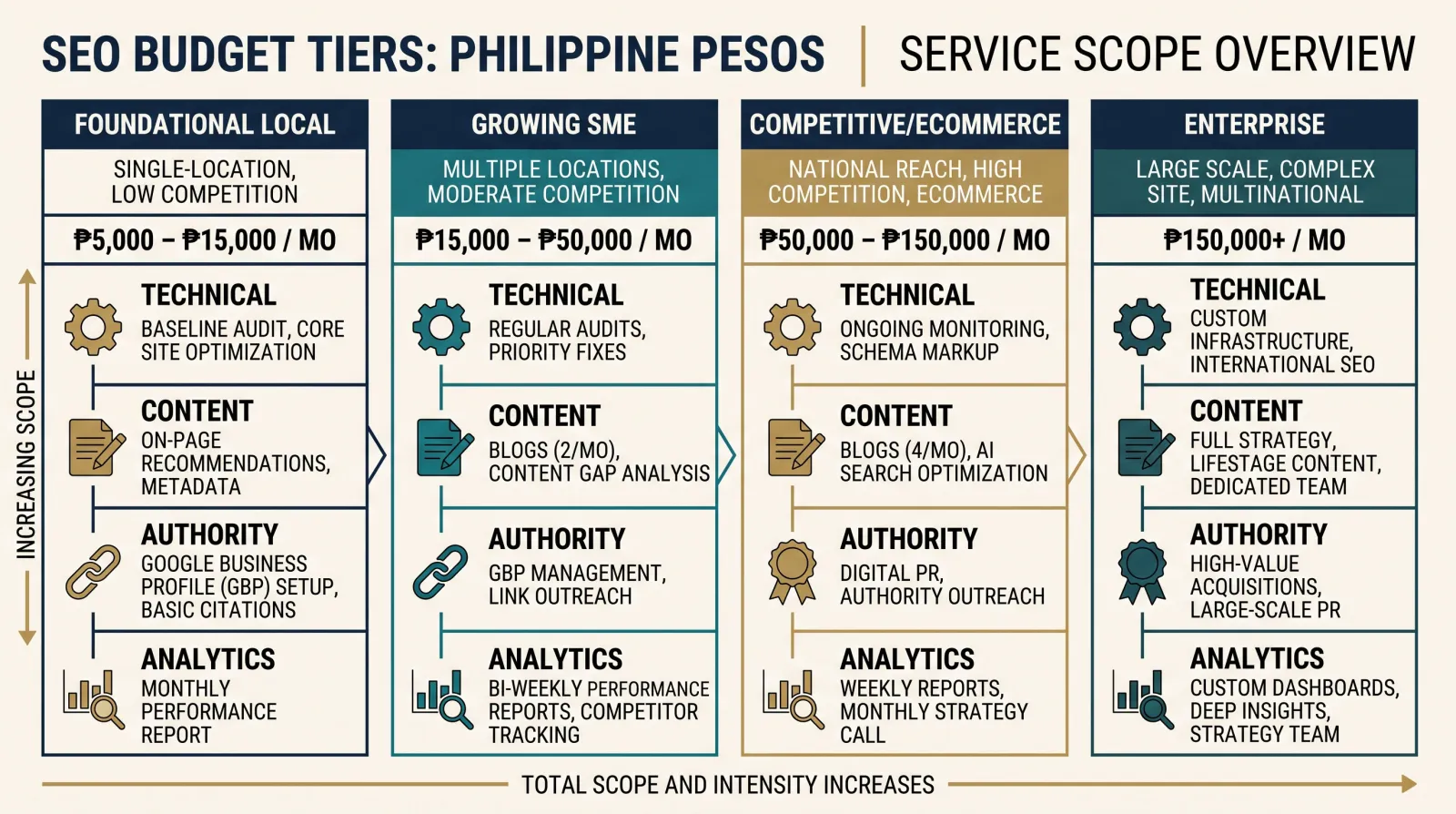
For most small and mid-sized businesses, a useful planning range is roughly ₱15,000 to ₱150,000+ per month. Lower budgets usually cover a narrow local or foundational scope; higher budgets fund more technical work, content production, digital PR or link earning, multiple markets and deeper reporting.
Monthly planning tier
Typical fit
Likely scope
Important limitation
₱15,000–₱30,000
Small local business or a narrow site
Foundational audit, priority on-page fixes, GBP/local work, light reporting
Limited content volume and outreach; results depend heavily on starting condition and competition.
₱30,000–₱75,000
Growing SME in a moderate market
Technical fixes, keyword/content plan, regular optimisation, selected content, local/off-page work
Scope must still be prioritised; not every channel or page can be tackled at once.
₱75,000–₱150,000
Competitive SME, ecommerce or multi-location brand
Ongoing technical SEO, content production, digital PR/link earning, CRO support and deeper reporting
Requires clear goals, approvals and internal subject-matter access.
₱150,000+
Enterprise, multi-market or complex platform
Large-scale content, migrations, international SEO, engineering collaboration and advanced analytics
Needs governance, cross-team ownership and a detailed statement of work.
These are budgeting tiers, not fixed market rates. Public Philippines-focused guides reviewed for this article publish ranges from about ₱15,000 to ₱500,000+ per month, depending on how they define business size and scope. Ask every provider to tie price to deliverables, effort, dependencies and expected measurement—not to a vague package name.
Why Does SEO Pricing Vary So Much?
SEO is not one task. It combines research, technical implementation, content, digital authority, local visibility, analytics and ongoing iteration. Two proposals with the same monthly fee may contain completely different work.
1. Your website’s starting condition
A new five-page brochure site needs a different plan from a 20,000-product ecommerce store with duplicate URLs, rendering problems and an international migration. The more technical debt and content cleanup involved, the more specialist time the project requires.
2. Competition and geographic reach
Ranking for a specialised service in one Cebu district is different from competing nationally for insurance, finance, healthcare or ecommerce terms. Broader geography and higher commercial value usually increase the content, authority and technical standard needed to compete.
3. Content requirements
A campaign that optimises existing pages costs less than one requiring research, subject-matter interviews, original images, landing pages and several expert articles each month. Quality assurance also matters: accurate content, editing, design and fact-checking require real time.
4. Implementation responsibility
Some providers only deliver recommendations. Others implement changes in WordPress, Shopify or a custom application, coordinate with developers and verify releases. A cheaper advisory quote may become more expensive when your team must supply the engineering work.
5. Reporting and strategy depth
Basic rank reports are inexpensive. A useful programme connects Search Console and analytics data with qualified enquiries, revenue, location performance, content contribution and technical health. Strategy, interpretation and stakeholder reporting add value beyond exporting a dashboard.
Common SEO Pricing Models
Model
How it works
Best for
Watch for
Monthly retainer
Fixed recurring fee for an agreed ongoing scope
Businesses building sustainable visibility over 6–12+ months
Unclear monthly deliverables or rollover rules.
Project-based
One price for an audit, migration, strategy or defined implementation
Specific problem, launch or diagnostic phase
Recommendations without implementation support.
Hourly consulting
Pay for specialist time
Training, reviews, troubleshooting and senior advice
No cap, vague time records or work that needs a project plan.
Performance-linked
Part of payment depends on agreed outcomes
Mature measurement environments with controllable definitions
Incentives focused on easy rankings, branded traffic or risky tactics.
In-house
Salary, tools and contractor support
Organisations with continuous workload and internal execution needs
A single hire may not cover technical, content, local and outreach skills.
A monthly retainer is common because search performance changes over time: competitors publish, sites change, technical issues emerge and content needs improvement. However, ongoing billing is only justified when the provider can show an ongoing plan, completed work and measured learning.
What Should an SEO Package Include?
A credible package should describe outcomes, deliverables, ownership and measurement. It does not need every item below every month, but the proposal should explain which work is included, when it happens and who implements it.
· Discovery and baseline: business goals, conversion actions, audience, competitors, analytics access and current performance.
· Technical SEO: crawlability, indexation, canonicalisation, internal linking, mobile usability, performance, structured data and migration risk where relevant.
· Keyword and intent research: prioritised topics mapped to suitable pages rather than a raw keyword export.
· On-page optimisation: titles, headings, copy, entities, media, internal links and conversion paths.
· Content strategy and production: briefs, expert input, writing, editing, publishing support and refresh decisions.
· Local SEO where relevant: Google Business Profile, consistent business information, location pages, reviews and local relevance.
· Authority development: legitimate digital PR, partnerships and link earning—not paid-link volume sold as a shortcut.
· Measurement: Search Console, analytics, leads or revenue, monthly interpretation and an action plan.
· Governance: approvals, account ownership, deliverable schedule, exclusions, confidentiality and exit terms.
Google’s SEO Starter Guide is a useful baseline for understanding the work a provider may recommend. Google also states that paying does not guarantee crawling, indexing or rankings; organic search cannot be bought directly.
How to Choose the Right SEO Budget
Choose a budget by matching your objective, competitive gap and implementation capacity—not by buying the package with the longest checklist.
1. Define one commercial outcome. Examples: qualified local enquiries, ecommerce revenue from non-brand search or lower dependence on paid acquisition.
2. Set the baseline. Record current organic clicks, leads, conversion rate, indexed pages, local visibility and major technical constraints.
3. Estimate the opportunity. Identify the services, products and locations with enough demand and business value to justify investment.
4. Price the required scope. Separate strategy, implementation, content, engineering, outreach and measurement so hidden dependencies are visible.
5. Fund a meaningful test period. SEO generally needs months, not days. Set milestones for implementation and leading indicators before expecting mature revenue impact.
6. Review against outcomes. Continue, change scope or stop based on completed work, quality, learning and business results—not a single ranking screenshot.
Practical rule: If the budget cannot fund all priorities well, narrow the scope. One location, service line or product category executed properly is usually more useful than a thin campaign spread across the whole site.
Freelancer vs Agency vs In-House SEO
Option
Advantages
Trade-offs
Good fit
Freelancer
Direct access, flexible scope, often lower overhead
Capacity and skill coverage vary; continuity risk
Focused audits, content, local SEO or specialist advice.
Agency
Broader team, tools, processes and implementation support
Higher fee; quality and senior involvement vary
Ongoing multi-discipline campaigns and growing businesses.
In-house
Deep business knowledge, daily access and control
Salary plus tools; one person rarely covers every speciality
Companies with sustained workload and internal development/content teams.
Hybrid
Internal owner plus external specialists
Requires clear roles and coordination
Often the strongest model for SMEs that can assign a capable internal lead.
How to Compare SEO Proposals Fairly
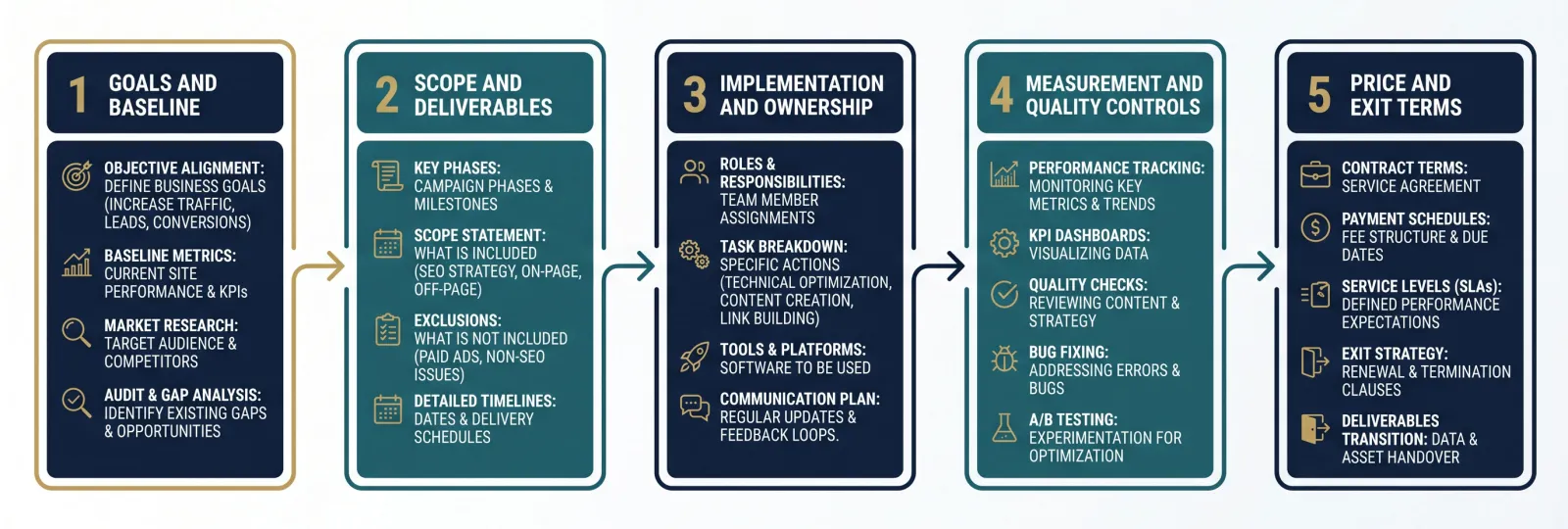
Normalise every proposal into the same comparison sheet. Package names such as “Gold” or “Premium” do not tell you whether the work is technically appropriate or commercially useful.
Comparison field
What a clear proposal should show
Goal
The business result and search opportunity being targeted.
Baseline
Current visibility, technical condition, content inventory and conversion tracking.
Deliverables
Specific audits, fixes, pages, content, local work, outreach and reporting.
Frequency
What happens once, monthly, quarterly or only when needed.
Implementation
Who changes the website, publishes content and resolves developer tickets.
Quality standard
Research, editing, expert review, originality and link-earning method.
Measurement
Clicks, qualified conversions, revenue where possible, and leading indicators.
Ownership
Your control of the website, Search Console, analytics, GBP, content and accounts.
Exclusions
Development hours, content volume, paid media, tools, photography and third-party fees.
Exit terms
Notice period, handover, data export, account access and unfinished deliverables.
Score proposals on relevance and execution quality before price. A ₱25,000 proposal can be expensive if it produces generic reports and no implementation; a higher fee can be efficient if it fixes valuable technical issues, publishes expert content and measures qualified leads.
Cheap SEO Warning Signs
Low price is not automatically bad. Risk appears when a provider cannot explain the work, owns your accounts, promises guaranteed rankings or relies on tactics that conflict with search-engine policies.
· Guaranteed number-one rankings or a fixed ranking date.
· Hundreds or thousands of “backlinks” without source quality, relevance or editorial explanation.
· Content published at scale with no subject-matter review, originality check or brand approval.
· Reports showing only rankings and impressions, with no conversions or completed-work log.
· No access to Search Console, analytics, Google Business Profile or content created for your business.
· Doorway pages, hidden text, copied location pages or other tactics designed primarily to manipulate rankings.
· A long contract with vague deliverables and no clean handover process.
Before signing, compare the proposed tactics with Google’s spam policies for web search. Policy-violating practices can lead to lower visibility or removal from search results.
How to Estimate SEO ROI
Estimate SEO value using qualified conversions and gross profit, not traffic alone. A simple planning model is:
Break-even conversions per month = monthly SEO cost ÷ gross profit per converted customer.
Example: if SEO costs ₱40,000 per month and an average new customer contributes ₱10,000 in gross profit, the programme needs about four additional converted customers per month to cover the monthly fee once the campaign reaches a productive stage. This is a planning estimate, not a guarantee.
Also consider assisted conversions, repeat purchases, branded demand and the value of website improvements across paid, email and direct traffic. Agree on attribution rules before the campaign starts.
Use the Google Search Console Performance report to monitor clicks, impressions, click-through rate and query/page trends. Combine it with analytics and CRM or sales data to evaluate business outcomes.
How Long Does SEO Take?
Meaningful SEO progress usually takes months rather than days, but the timeline depends on the starting point, implementation speed, crawl/indexing, competition and content quality. Technical fixes can be completed quickly; search engines still need time to recrawl, reprocess and reassess pages.
Use staged milestones: first 30–60 days for baseline, technical priorities and initial content; 60–120 days for implementation coverage and early visibility trends; later months for stronger non-brand traffic, authority and conversion evidence. These are planning phases, not guaranteed ranking deadlines.
Questions to Ask Before Hiring an SEO Provider
1. Which business outcome and search opportunities will you prioritise first?
2. What does the first 90-day plan include?
3. Who performs strategy, technical work, content and account management?
4. Who implements recommendations on our website?
5. How do you earn links, and can you explain the quality controls?
6. Which accounts and assets will our business own?
7. How will you measure qualified leads or revenue, not only rankings?
8. What is excluded from the quoted fee?
9. What happens if priorities change or we end the engagement?
10. Can you show an anonymised example of a work log and decision-focused report?
Frequently Asked Questions
How much does SEO cost in the Philippines?
A practical planning range is about ₱15,000 to ₱150,000+ per month, while public agency guides sometimes extend to ₱500,000+ for enterprise work. Scope, competition, website size, content volume, engineering needs and provider expertise are the main cost drivers.
Is SEO usually a monthly fee?
Often, yes. Monthly retainers suit ongoing optimisation, content and measurement. One-time project fees are also common for audits, migrations, strategy or a defined implementation sprint.
What is the cheapest sensible SEO option?
For a small local business, a narrow foundational scope may be sensible: accurate measurement, technical priorities, essential service pages and Google Business Profile work. Avoid packages that promise large quantities of links or content without quality controls.
Should I hire a freelancer or an agency?
Choose a freelancer for focused work when one specialist can cover the need. Choose an agency when the campaign requires coordinated technical, content, local, outreach and reporting capabilities. A hybrid model often works well when your business has an internal owner.
Can I do SEO myself?
Small businesses can handle fundamentals such as accurate business information, useful service pages, Search Console monitoring and customer-focused content. Specialist help becomes valuable for technical problems, migrations, competitive content strategy and scalable implementation.
Does paying Google improve organic rankings?
No. Google states that it does not accept payment to crawl a site more frequently or rank it higher. Ads and organic search are separate systems.
Can an SEO company guarantee first place?
No credible provider controls Google’s results. Providers can guarantee deliverables and professional standards, but not a specific organic ranking by a fixed date.
How often should SEO performance be reviewed?
Review completed work and leading indicators monthly, strategy and business outcomes quarterly, and the full scope at least every six months. Avoid reacting to normal daily ranking fluctuations.
Build a Budget Around the Work Your Business Actually Needs
The best SEO budget is not the lowest or highest quote. It is the smallest credible investment that can address your real technical, content, authority and measurement gaps at an appropriate pace.
Start with a clear objective, compare like-for-like deliverables, retain ownership of your accounts and judge performance by qualified business outcomes. That approach makes SEO pricing easier to understand—and makes providers easier to evaluate.
If your search visibility depends on website structure, performance, content or conversion improvements, discuss your SEO and website growth plan with Southside Devs. We can help you define the right technical and content priorities before you commit to a larger programme.